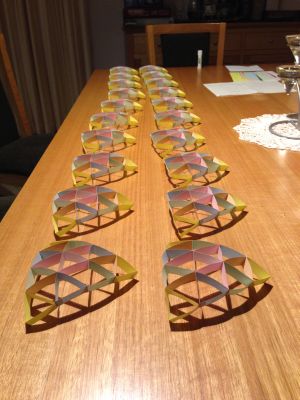
Way back in January, a guy at work sent me a link to some nets for making Villarceau Circles. So I made a couple of the 16 piece ones. One day I should try the 24 piece one.


Boring Life Of a Geek
Way back in January, a guy at work sent me a link to some nets for making Villarceau Circles. So I made a couple of the 16 piece ones. One day I should try the 24 piece one.
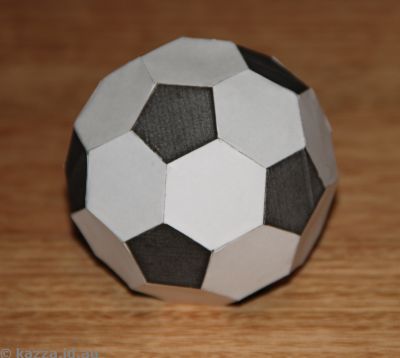
So the dodecahedron and the icosahedron are dual solids. The icosahedron has 20 faces and 12 vertices, while the dodecahedron has 12 faces and 20 vertices. It means that if you truncate either one of them to the same point, you send up with the same shape - the icosidodecahedron.
I made the paper solid from a net from korthalsaltes.com..
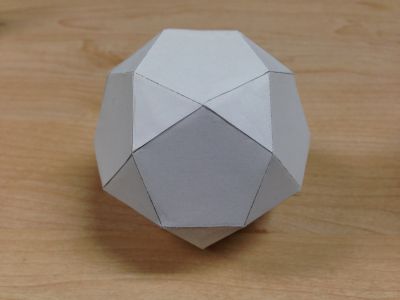
And I made the paper geodesic version from Vince Matsko.. (If using his nets, you will need three pages of the pentagons, and one page of the triangles. The tabs for the five triangles making up each pentagon will go in the middle. The triangle is equilateral so doesn't matter where you put the tab).

Here's the two of them together..


Over the past few weeks I've been making the paper geodesic icosahedron pictured above.
As with all my other balls in the past few months, I got the nets from Vince Matsko's website. The problem with this model is his instructions aren't very useful if you don't have Magnus Wenninger's Spherical Models book:
Not so challenging as its 8-frequency companion, this model requires just 320 individual spherical triangles of 5 distinct types. Bands are labelled numerically as in Figure 48 (p. 95) of Wenninger's Spherical Models. Although not individually labelled, the bands adhere to the following scheme: in Table 4, the arc in the third column of the list of bands is always next to the tab. You can easily check this by noting that in a circle, larger angles subtend larger chords, so you can measure chords to find out which angle is which.
The finished model will be approximately 14 inches (36 cm) in diameter.
Vince's net pdf document contains bands for the five different triangles. But without Wenninger's book, you've got no way to know which band is which. So here's one I prepared earlier:
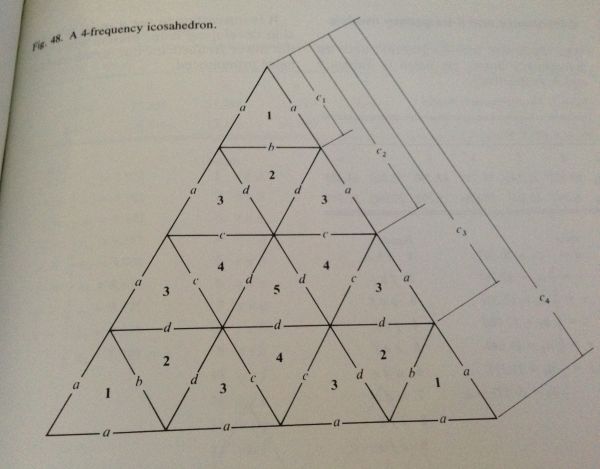
You can see from the diagram there are five different shaped triangles, numbered 1 to 5. This matches the pdf document on Vince Matsko's site. Also take note of the lettering - letters a to d indicate the length of each side (remember these aren't equilateral triangles! see Wenninger's book for more details on the mathematics of it).
The next line of instructions:
Although not individually labelled, the bands adhere to the following scheme: in Table 4, the arc in the third column of the list of bands is always next to the tab.
Again, without the book you've got no hope. And even if you do have the book, it can take a while to figure out what he actually means. Eventually I figured it out. Here's the table he's talking about:

Highlighted on the right is the "third column" he's talking about. If you look at the first picture from the book further up, you can see that triangle number 1 has "a", "a", and "b" as the lengths of its bands. And triangle 2 has "b", "d" and "d". And so on. The table above shows this as well. Now, in the table above, what he's saying is that the "tab" in the printouts is always next to the letter in the third column. So for triangle 1, in his pdf it will be a-b-a-tab. Triangle 2 will be d-b-d-tab, and so on. Here's what it will look like:

You'll note above that triangle 3 is asymmetric (look at the big triangle at the top to confirm this). Half the triangles are "left-handed" and half are "right-handed". If you were to print out all the copies of triangle 3 and fold them the same way it wouldn't work.
Here's the diagram from the book, but also showing the locations of the tabs once it's all put together, and showing left and right handed triangle 3.

Now the triangle above is just one "face" of an icosahedron. Remember an icosahedron has twenty sides. So you will need 60 bands for triangle 1, 60 for triangle 2, 120 for triangle 3 (60 left-handed and 60 right handed), 60 for triangle 4 and 20 for triangle 5. Using Vince Matsko's nets that's 10 pages for 1, 2 and 4, 20 pages of 3, and 3.3 pages of 5 (4 pages with a couple of leftovers).
But. If you were to print out the nets on A4 paper, the ball would be *huge* - double the size he says in his instructions. So I resized the images and pasted them into a word document. While I was at it, I flipped a copy of triangle 3 so the black lines would always be on the outside. Attached is my word doc with the nets that I used. It includes instructions on how many of each triangle you will need.
Right. So now we've got the design sorted, let's get started.
I printed each triangle on a different coloured piece of paper. And for triangle 3, I did the left and right handed triangles on different coloured paper (blue and green).

Next, cut them up. Each one took about thirty five seconds to cut.
Once they're cut, fold them up. I folded them so that the black line from the printout would always been on the outside. Each one took about twenty five seconds to fold. I did most of this in front of the tv.

Once they're glued into triangles (each one took about fifteen seconds), you can lay them out to see what they will look like before gluing.

I started a production line - got all sixteen little triangles for each face and put them together.

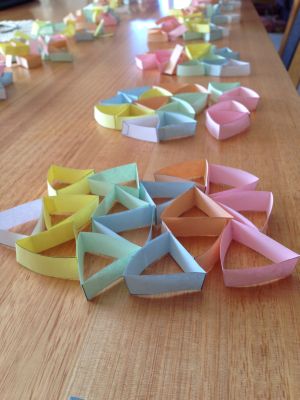
Then I put them together in the correct configuration, with all the tabs in the correct locations.

And then glued them all together. Here's all twenty faces glued:
Now for the really fun part - gluing all twenty faces together into a ball!


With six faces to go, it will fit quite nicely over your head.. ;)

And finally, we're finished!
A very time consuming, but quite impressive effort :)
Another model I started making nearly three years ago was a paper geodesic octahedron.

Or, if you please, a geodesic hexahedron (cube).

It's a dual model because the model is made up of forty-eight triangles and you can look at it as eight faces of six triangles (octahedron), or six faces of eight triangles (hexahedron/cube).
This was another pretty simple model to make, with the net taken from Vince Matsko. You'll need to print eight pages of that net, but there's a catch: you need to make half of the triangles "left-handed" and half of the triangles "right-handed" - folding the strips "inwards" for half, and "outwards" for the other half. If you want to make a two-colour model, as I have above, you'll need to make all the triangles of one colour left-handed, and all the triangles of the other colour right-handed. Again, I stuffed this up when I was making it, and so I've had to make two models - oops!
A little while ago (crap it was nearly three years ago!) I started building one of Vince Matsko's geodesic dodecahdrons out of paper, based on Magnus Wenninger's Spherical Models. I finished it a weekend ago (after realising I'd stuffed up when I started and was trying to do it with three colours, but it looks a lot better with four colours, so had to make the white pentagons as you see below).

It's a pretty straightforward model to build. Each pentagon face of the twelve faces of the dodecahdron is divided into five triangles, so you'll need sixty triangles. Vince Matsko's net has twenty per page, so you'll need three pages. Although if you want to make different colours like I have you may need more and have some leftover. When you fold each strip, the little tab will always be right in the middle of the group of five triangles. I stuck each group of five triangles together, giving me the twelve faces, then glued the twelve faces together into the ball.
A simple and fun little model to make.
4.4.14-6.4.14
After the Lego movie I went home to get my car and *stuff* then headed out to the club to meet up with the sweetie who went out earlier in the day.
We had the place to ourselves for most of it which was nice. Saturday afternoon I went for a wander around the perimeter.


It rained most of the weekend too, so the planned hazard reduction bonfire never went ahead. I cut and folded and glued little bits of paper.


I left Sunday morning to get a quick visit in to the Airport Open Day.
Just a stack more photos that still haven't made it online..
A truncated dodecahedron I made for a guy at work

George, who jumped onto my seat straight after I got up because it was warm

Some daffodils out the front

Lego R2-D2 and C-3PO in Myer in Sydney

Lego mosaic in Myer in Sydney

Sometimes the algae in the pool gets away from me.

Add flocculent and wait a day for it to settle

Vaccum to waste - shiny!

A lovely dragonfly at work that obligingly sat still for us to photograph it

A ginormous caterpillar - a White-Stemmed Gum Moth

The Birds! A huge flock of galahs out the back (this wasn't even all of them)

Neil with his brand new car that he got himself for Christmas. His last car was a Datsun 120Y that he bought new - in 1978!